What is a Device Trust Platform — and how is it different from EDR or MDM?
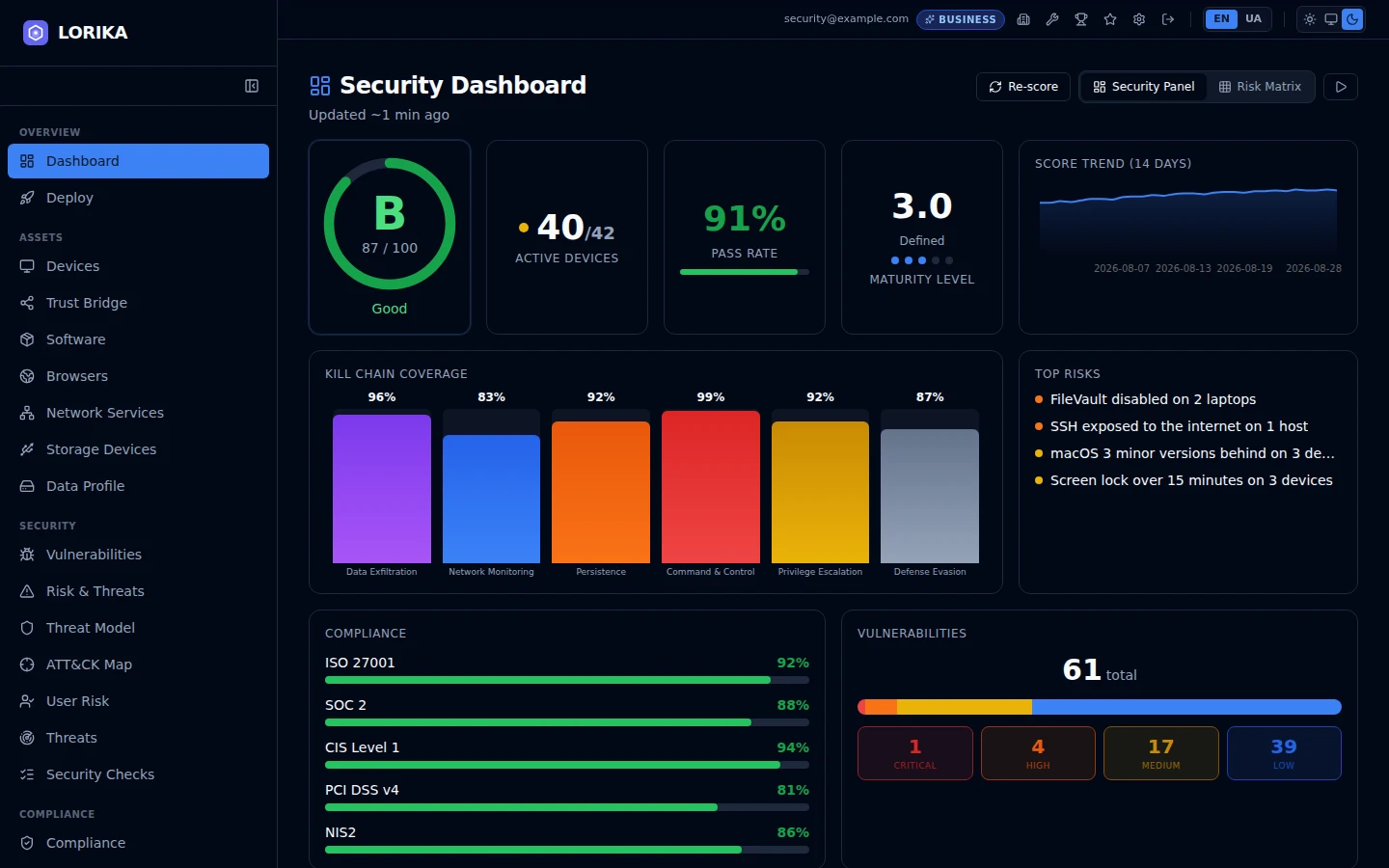
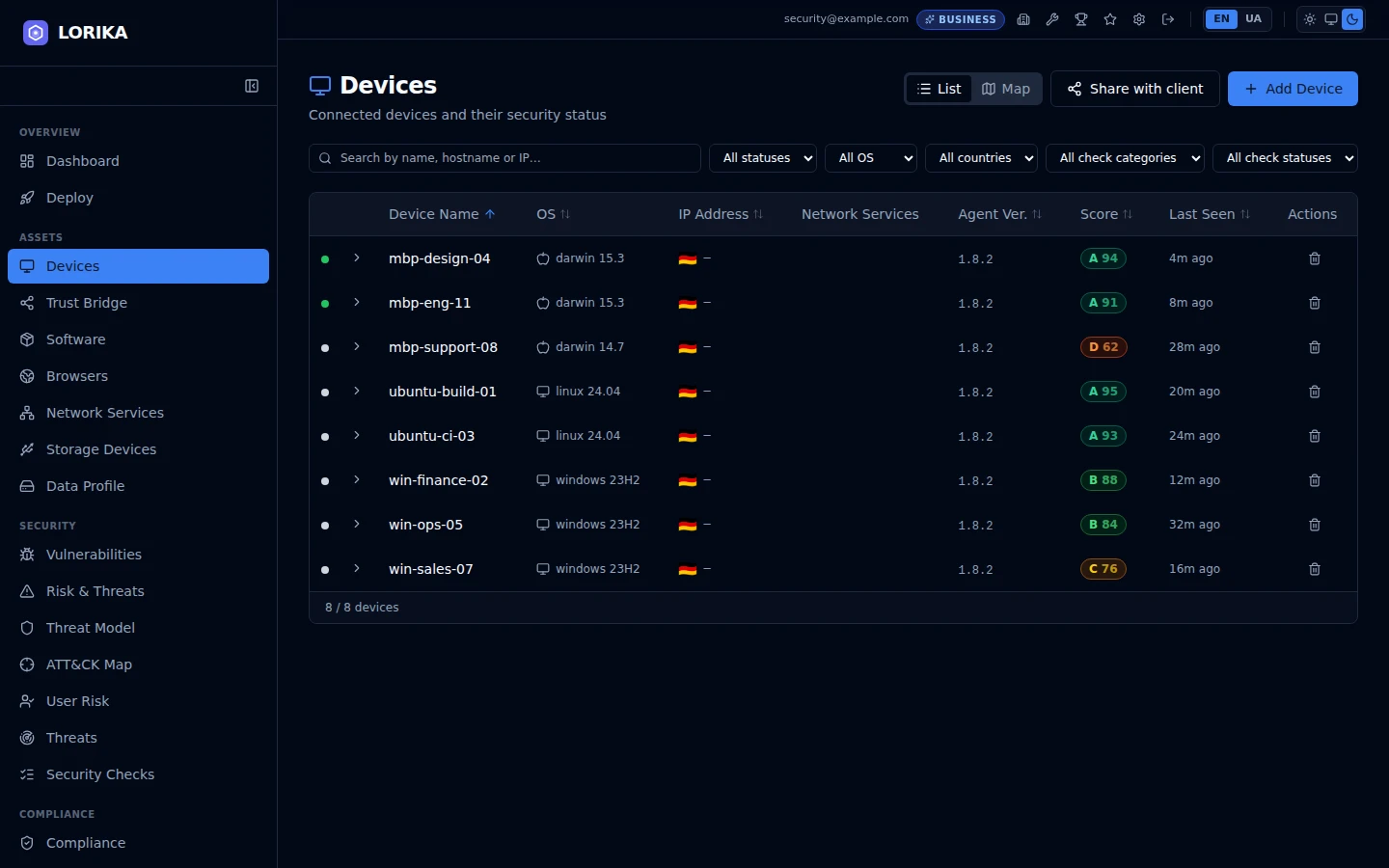
A Device Trust Platform continuously verifies whether each endpoint is in a safe state before it accesses corporate resources. EDR detects active attacks; MDM enforces device configuration. Lorika sits between them: 210+ posture checks, mapped to 18 compliance frameworks, with a real-time Security Score for every device. We're the layer Zero Trust gateways consult to decide "is this device safe to grant access to right now?"
What does the agent collect — and do you read my files?
No file contents, no screen captures, no keystroke logging. The agent reads OS configuration: firewall state, disk-encryption status, password policy, installed-package list, network services, kernel hardening flags. The full check list is open and documented in our Trust Center. The agent runs as a least-privileged service account — read-only telemetry, no data modification.
Is the free Personal tier really free forever?
Yes — up to 10 devices, all 210+ checks, all 18 compliance frameworks, 90-day scan history, no credit card required, no time-limited trial. We mean "free forever" the way Cloudflare means it for their free DNS: a real product, not a pitch.
How long does it take to deploy across a fleet?
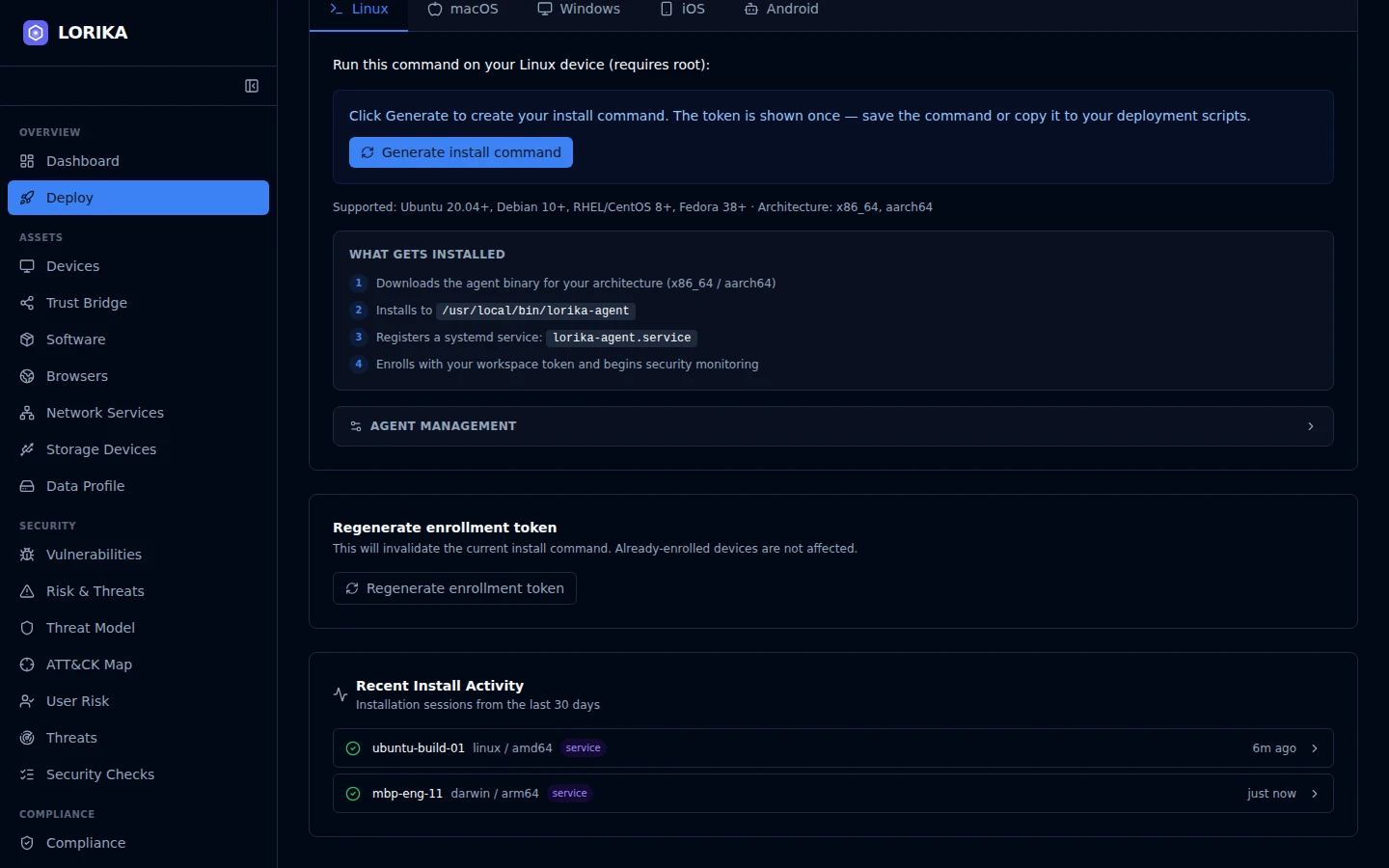
A single device: 47 seconds from sign-up to first Security Score. A 100-device fleet: usually a single afternoon. The agent installer is a one-line shell command on macOS/Linux and a signed MSI on Windows — deployable via Jamf, Intune, Group Policy, or any MDM. No manual configuration per device.
Where is my data stored?
EU data residency by default. Production database is encrypted at rest (LUKS, TPM-bound keys), backed up nightly to encrypted EU object storage, with a verified weekly restore drill. Full infrastructure transparency in our Trust Center. We never sell or share customer telemetry.
Do I need MDM permissions to install the agent?
No. The agent runs entirely in user space — no kernel extensions, no MDM enrolment required. That's by design: customers tell us MDM friction is the #1 reason endpoint security tools don't ship across BYOD fleets. Lorika installs like any other LSP-style daemon.
What happens when a device fails a check?
The Security Score drops, the failed check shows up in the dashboard with plain-English remediation guidance, and (if you've wired it up) a Zero Trust gateway can deny access to sensitive resources until the device passes again. Failures don't auto-quarantine — Lorika is a posture signal, not an enforcement layer.
Which compliance frameworks does Lorika support?
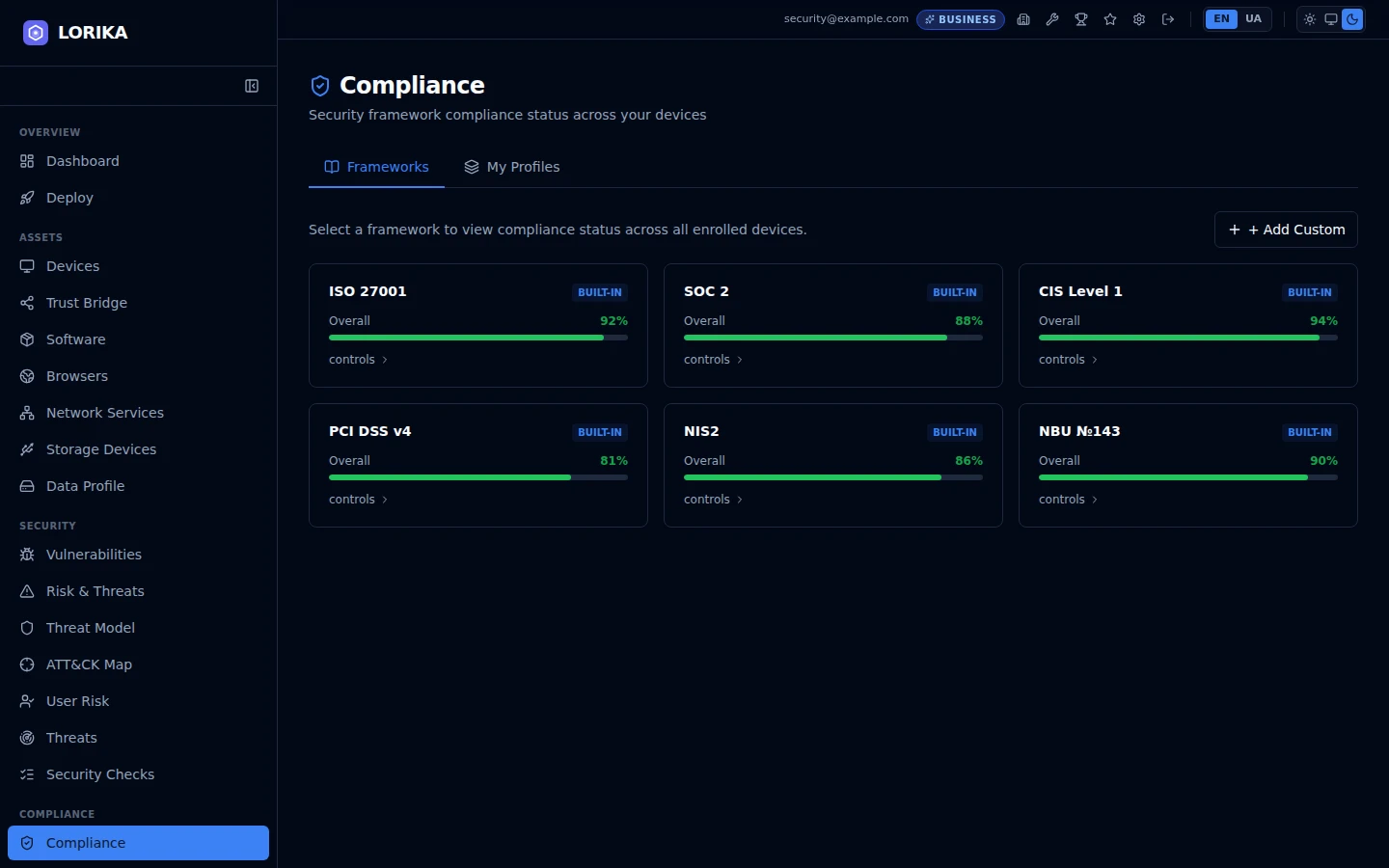
CIS Controls v8.1, NIST 800-53, NIST CSF 2.0, NIST 800-171, ISO 27001, SOC 2 Type II, PCI DSS v4.0, NIS2, CMMC, UK Cyber Essentials, AU Essential Eight, SG Cyber Essentials, DORA, EU CRA, NBU №143, NBU №95, ДССЗЗІ №75 — plus a custom-framework builder. Every check is pre-mapped, so the same evidence supports multiple audits.
How do I migrate from my current EDR / MDM?
You don't have to. Lorika is complementary, not replacement — it runs alongside EDR (CrowdStrike, SentinelOne, Defender) and MDM (Jamf, Intune, Kandji) without interference. Most customers keep both and use Lorika as the audit-and-Zero-Trust layer.
Where can I see the source — is the agent open?
The agent is open-source (and Sigstore-signed for supply-chain integrity). The dashboard backend is closed but extensively documented at docs.lorika.dev. Public SBOM at /api/v1/meta/sbom for procurement teams that want it.